Construction
Where Construction Debris Actually Goes Around Loganville
The city names construction debris and refuses it outright. Here is where the material actually goes instead, and where the cheaper routes are.
The line the city draws
The City of Loganville's curbside service is genuinely decent — two household bulk items a week on top of the cart. But it draws one line very clearly, and it is the line that defines this whole trade.
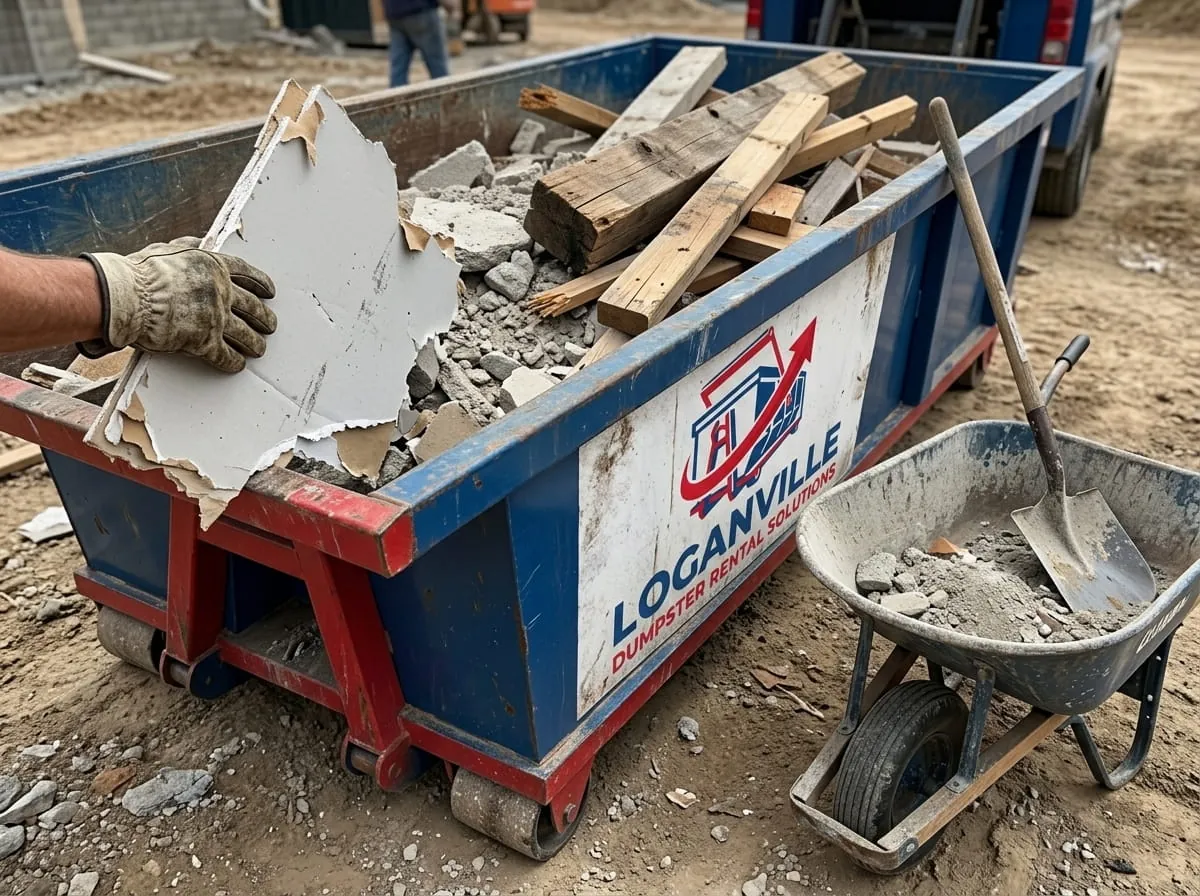
Read that against an actual renovation. A bathroom gut produces a toilet, a vanity, tile, drywall and flooring. A kitchen produces cabinets, countertop and appliances. A basement produces panelling, carpet and framing by the ton. None of it is collectable.
Outside city limits it is starker still. Unincorporated Walton households have no curbside collection at all — the county Green Bag programme is bags at a convenience site, which is no use whatsoever for building material. Gwinnett residents are on approved-hauler arrangements with two bulk items a week, and construction debris is not a bulk item.
The disposal sites around us
Worth knowing what actually exists locally, because the options are better here than in most markets we work.
- An inert landfill in Loganville itself, taking construction and demolition debris.
- An inert recycling facility on Highway 81 in Loganville, taking earth, concrete, cured asphalt, rock, brick, yard trimmings and land clearing debris — and selling clean fill, sand, gravel and crusher run back out.
- The Walton County landfill out on Highway 78 toward Monroe, taking C&D.
- Oak Grove on Carl-Bethlehem Road up toward Winder, in Barrow County.
- The Newton County landfill on Lower River Road at Covington — which takes material from Newton County residents rather than out-of-county waste, so it is not an option for a Loganville job.
That last point matters. People assume the nearest landfill is available to them; several around here are county-restricted.
The inert route is the big saving
This is the most useful thing on this page for anyone doing demolition.
Mixed C&D is the most expensive stream per ton. Clean inert material — concrete, brick, rock, cured asphalt, earth — does not have to go into it. There is a facility on Highway 81 that takes exactly that material and recycles it, then sells it back out as fill, gravel and crusher run.
On a demolition producing a slab, a walkway and a set of block steps, keeping that material clean and routing it separately is routinely the single largest saving available on the job.
The condition is that it is genuinely clean. Timber, drywall, plastic sheeting or general rubbish mixed in and it is heavy mixed waste again, at the mixed rate, and you have lost the advantage.
Why stream separation saves money
Disposal is priced per ton and the rate varies by stream. Mixed C&D is dearest. Clean inert is cheaper and locally recycled. Land clearing debris has its own route. Scrap metal has positive value.
Consider a lot clearance producing eight tons of concrete and slab, six tons of stumps and brush, and eight tons of mixed building debris. All in one container and you pay the mixed rate on twenty-two tons. Split it three ways and only the last eight tons is billed at the top rate. Even after paying for extra movements, the split usually wins comfortably.
The five streams worth separating
1. Clean concrete, block, brick and rock
Rebar is generally fine. Timber, plastic sheeting and general debris are not. Goes in a 10 yard because of weight, always.
2. Earth, clay and cured asphalt
Distinct from the above and worth separating in its own right if you have volume, because the inert facility takes and sells exactly this material.
3. Land clearing debris
Stumps, limbs and leaves. Keep the clay knocked off, because soil is what turns a light vegetation load into a heavy one.
4. Scrap metal
Copper pipe, steel studs, ductwork, conduit, rebar offcuts and appliances. Out in the county, barn sheeting and old implements.
5. Clean dimensional lumber
Untreated, unpainted, fasteners removed where practical. Treated timber does not qualify, which matters here because deck and fence timber nearly always is.
Red clay changes demolition maths
Worth its own section because contractors coming in from outside the Piedmont get it wrong.
Georgia red clay is heavy, and it holds water, which makes it heavier. On any job involving footings, old fence lines, stump removal, grading or slab breakout, clay comes up with the material and it does not look like weight until the ticket arrives.
Two practical consequences. Soil belongs in a 10 yard, part-filled — never a larger container, which cannot be legally hauled once full of clay. And knock the clay off anything you can before it goes in.
The wet-season effect is real too. Clay that has taken sustained rain can be half again as heavy as the same volume dry, and a site route that carried loaded trucks through September will not necessarily carry them in February.
Asbestos and pre-1980 buildings
There is a substantial stock of pre-1980 housing across this service area, and genuinely old fabric in Monroe, Covington, Oxford and Stone Mountain Village. Floor tile and its mastic, pipe lagging and textured coatings are the usual culprits.
Anything from before roughly 1980 should be treated as asbestos-suspect until surveyed. Abatement is licensed work with its own disposal route and it never goes in a roll-off container. Get the survey done before demolition starts rather than halfway through a strip-out.
Practical site setup
- Place containers where the work is, not where they are convenient for the truck. Labour spent walking debris across a site is the largest hidden cost in waste handling.
- Label them. A sheet of plywood marked CLEAN CONCRETE ONLY protects the cheaper route.
- Brief the trades. One subcontractor throwing a lunch bag into the clean inert container turns a cheap load into a billed one.
- Keep clear of overhead lines and trees. The truck bed needs roughly twenty-two feet of vertical clearance to tip.
- Book swaps into the programme, not on the day you notice the can is full.
- Watch the clay in wet weather. Site routes that work in a dry spell can rut badly after sustained rain, and a stuck loaded truck does more damage than the container ever would.
- Cover heavy loads if rain is coming. You pay for that water by the ton.
We are happy to help set that up — tell us the build programme and we will schedule around the trade sequence.
Need a container in Loganville?
Call and describe the job. Three minutes on the phone gets you a size recommendation, a flat rate and a delivery window — and we will tell you if a smaller, cheaper container is the right answer.
Call (678) 345-8751